

Fadi sent me his CV before he sent it anywhere else.
Eighteen years in supply chain. Regional director title. Three multinational logos on the top half of the page. On paper, he was exactly what half the Saudi job postings in his sector were asking for.
He applied to eleven roles that month. Four auto-rejections within the hour. Five with no response at all. Two interviews that went nowhere.
He asked me what was wrong with his experience.
Nothing was wrong with his experience. Something was wrong with how his experience was being read — or more accurately, how it was not being read at all.
THE PROBLEM
Most professionals believe a recruiter opens their CV and reads it the way a hiring manager reads a report — top to bottom, absorbing each line, weighing the details.
That is not what happens.
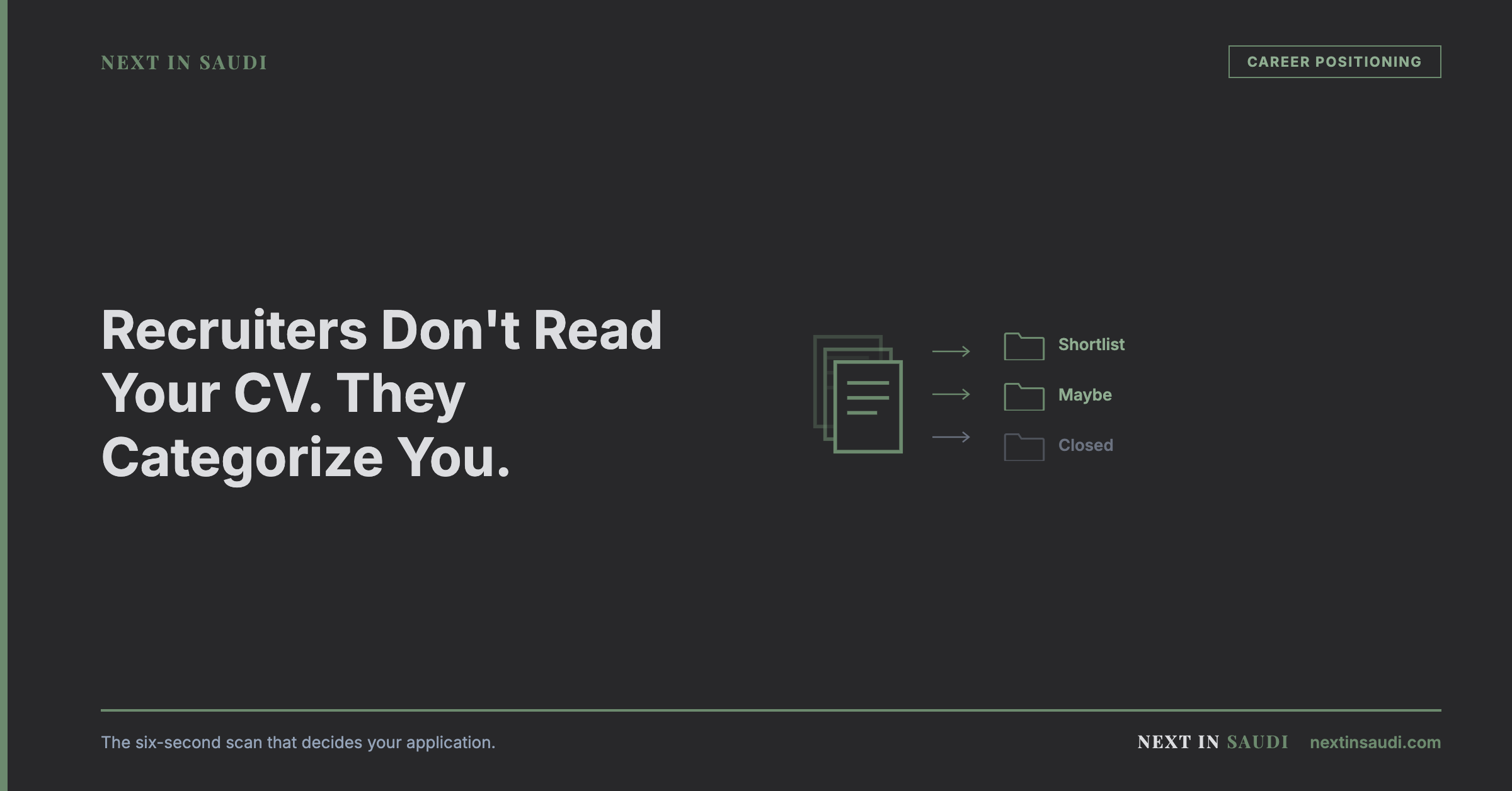
A Saudi recruiter screening for a mid-to-senior role is often looking at 80 to 200 CVs for a single opening. They are not reading. They are sorting. And sorting happens in seconds, not minutes.
The question running in their head is not “is this person good.” It is “where does this person go.” Which folder. Which shortlist. Which pile gets forwarded and which gets closed.
If your CV does not answer that question in the first six seconds, it does not matter how good your experience actually is. You have already been filed under “unclear” — and unclear does not get a second look.
THE REALITY
Recruiters categorize before they evaluate. This is not laziness. It is how anyone processes high volume under time pressure — the brain reaches for the fastest pattern match available.
A recruiter’s internal categories are simple and mostly unspoken: industry, seniority level, function, and whether the person looks like they belong in the Saudi market specifically or somewhere else entirely.
Fadi’s CV had all four signals present. But they were buried across three pages, mixed with responsibilities from four different sub-industries, written as duties rather than outcomes, and framed for a global audience rather than a Saudi hiring manager scanning for one thing: can I place this person somewhere in my org chart in under ten seconds.
He did not have a qualifications problem. He had a categorization problem. The recruiter could not file him quickly, so the recruiter moved on.
THE SYSTEM — HOW CATEGORIZATION ACTUALLY WORKS
1. The six-second scan
The eye goes to three places first: current title, most recent company, and the top line of the most recent role. If those three things do not immediately signal “this person fits category X,” the recruiter has already started building doubt before reading a single bullet point.
2. The folder, not the person
Recruiters in Saudi companies — especially at multinationals and PIF-linked entities — are often screening against a specific mandate from the hiring manager: “senior, oil and gas, EPC background, Arabic preferred.” Your CV is not being judged against your full career. It is being judged against that one sentence. If your CV does not visibly map onto that sentence, you are filed as “does not match,” even if you would have excelled in the role.
3. Duties versus outcomes
“Responsible for supply chain operations across the region” tells a recruiter your job title. It does not tell them your category of value. “Reduced regional logistics costs by 22% across four markets” tells them exactly where to place you — cost optimization, multi-market, senior operator. Outcomes categorize you. Duties describe you.
4. The narrative gap
When a CV shows movement across unrelated industries or functions without a clear throughline, the recruiter has to do work to understand why. Recruiters moving through 150 CVs in an afternoon will not do that work. They will file you under “unclear career direction” and move to the next file.
THE SHIFT
Stop writing your CV to be understood eventually. Write it to be categorized instantly.
This means accepting something uncomfortable: the fullest, most accurate version of your career is not what gets you shortlisted. The fastest-to-categorize version does.
That is not dishonesty. It is translation. You are not hiding your complexity — you are sequencing it so the first six seconds tell the recruiter exactly which folder you belong in, and the next six minutes (if you earn them) tell the fuller story.
3 SPECIFIC ACTIONS
1. Write a one-line positioning statement above your experience.
Not a generic summary. A single sentence that states your category directly: “Senior supply chain director — oil & gas and industrial sectors — regional cost and vendor optimization.” This is the label the recruiter is already trying to assign. Give it to them.
2. Rewrite your last three roles as outcomes, not duties.
For each role, find the number. Cost saved, revenue generated, team size scaled, timeline compressed. If you cannot find a number, find the specific result. “Duties” get skimmed. “Outcomes” get remembered.
3. Remove anything that does not support your category.
If you are positioning as a senior operations leader, the six-month stint in marketing from 2011 is not proof of range — to a recruiter scanning fast, it is proof of ambiguity. Cut it, or fold it into one line. Every unrelated detail costs you clarity, and clarity is the only currency that matters in the first six seconds.
CLOSING INSIGHT
Your CV has one job before it has any other job: answer the question “where does this person go” — instantly, without effort, without doubt. Everything else you want the recruiter to know about you comes after that question is answered, never before.
Want to go deeper?
The Next in Saudi community offers weekly live calls, personal CV and LinkedIn reviews, and direct guidance tailored to your specific situation.
Every Friday, Next in Saudi publishes one article like this.
This is a practical approach to fix the CV. At the end of the day, the candidate has to qualify for the job interview. The CV role is to make it happen.
I think you have to write more articles on CVs and their fixation. For example, how to write a CV in two pages, what is important, and what is not important.
The other thing is how to adjust the same CV for different roles. matching key words, aligning experience and outcome.
Very good insight as always, stay blessed!