

A supply chain director messaged me after six months of silence from the Saudi market.
Fifteen years of experience. Two continents. A track record of cutting logistics costs by double digits at every company he’d touched.
His conclusion, after six months of nothing: “Maybe I’m just not what they’re looking for.”
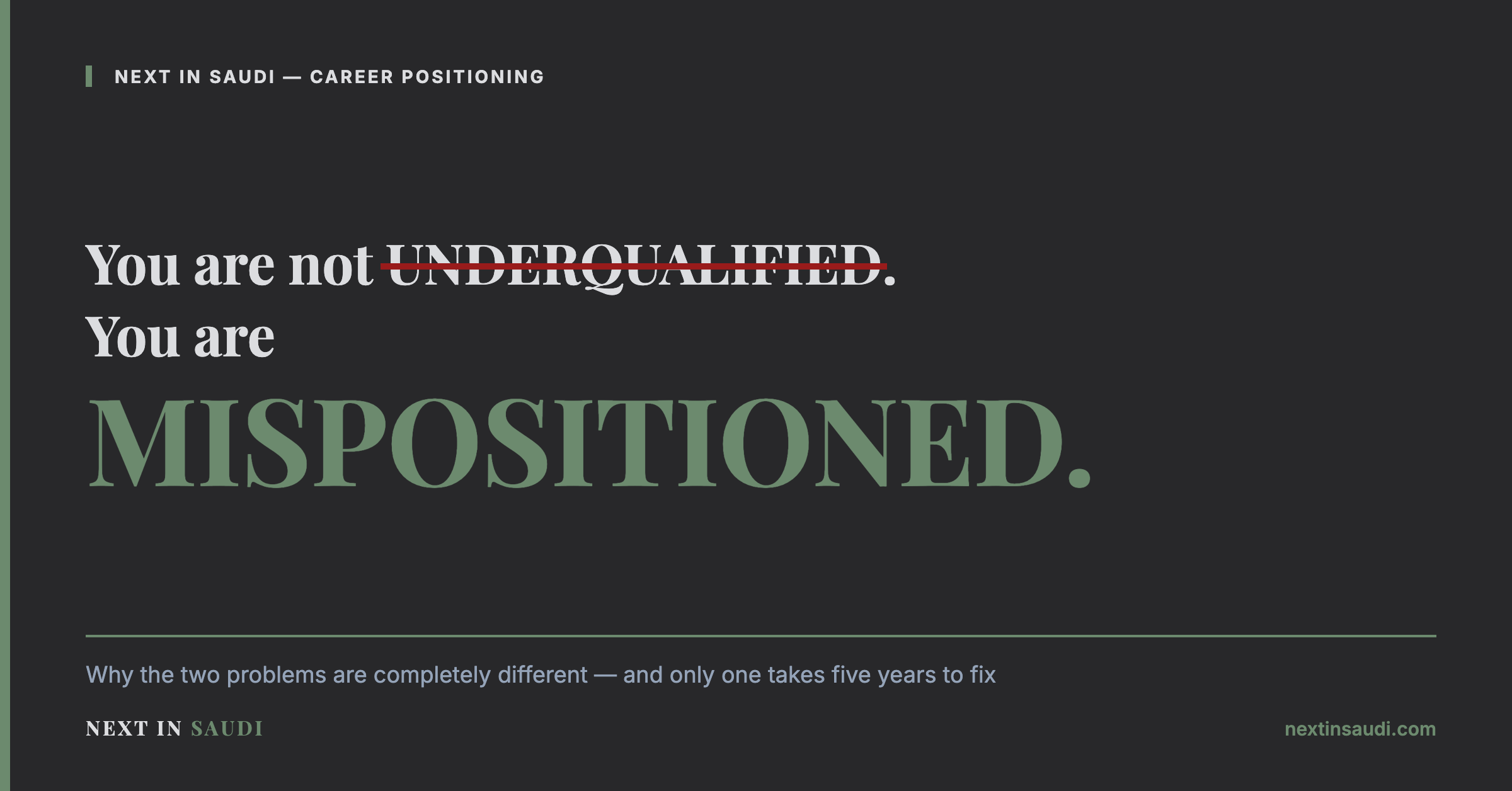
I read his CV and LinkedIn for ten minutes. He wasn’t underqualified. He was invisible — describing himself in a way that made his actual value impossible for a Saudi recruiter to see.
This distinction matters more than almost anything else in a Saudi job search, because the two problems have completely different solutions.
Underqualified Means You Need More. Mispositioned Means You Need Different.
If you are genuinely underqualified, the fix is time — more experience, more credentials, more years. That is a real problem, but it is rare. Most professionals messaging me about six months of silence are not short on qualification. They are decades deep in relevant experience.
Mispositioning is a different problem entirely, and it is fixable this week, not in five years.
What Mispositioning Actually Looks Like
The supply chain director’s LinkedIn headline read: “Experienced Operations Leader | Passionate About Efficiency | Global Mindset.”
Accurate. Also completely uncategorizable. A Saudi recruiter searching for “supply chain director GCC” would never surface him, because nothing in his headline, summary, or recent activity used language that maps to what they are searching for.
His experience was there. His positioning translated none of it into terms the Saudi market actually searches for.
Three Signs You Are Mispositioned, Not Underqualified
You get interviews outside Saudi, but not inside it. If your CV works in London or Singapore but goes silent the moment you target Riyadh or Jeddah, the problem is not your experience — it is that your positioning was built for a different market’s search logic.
People who know your work are surprised you are struggling. Former colleagues, managers, and clients who have seen you deliver are often the most confused by your lack of response rate. They already know your value. The market does not, because your public positioning does not say it clearly enough.
Your CV describes your journey instead of your fit. A CV built chronologically, explaining how you got from role to role, reads as a biography. A CV built around what you are ready to deliver next reads as a fit. Recruiters are not hiring your past. They are hiring your next move.
Why This Happens to Strong Professionals Specifically
Ironically, the more accomplished your career, the more likely you are to be mispositioned. A varied, senior career has more to explain — more roles, more industries touched, more range. Explaining all of it, accurately, produces a CV and profile that reads as broad rather than sharp.
Saudi recruiters, working through high application volume, do not reward breadth. They reward instant clarity about where you fit. The richer your career, the more deliberate you have to be about narrowing how you present it — not because the range isn’t real, but because nobody has time to discover it themselves.
The Shift From Underqualified Thinking to Mispositioned Thinking
“I’m underqualified” leads to defeat — waiting, doubting, sometimes giving up on the market entirely.
“I’m mispositioned” leads to action — because positioning is something you control, starting today, without needing a single additional year of experience.
This shift alone changes what people do next. Instead of adding more credentials or waiting for the “right” opening, they rewrite how they describe what they already have.
3 Specific Actions This Week
1. Read your LinkedIn headline as a stranger would.
Would a Saudi recruiter searching for your exact function and level find you? If your headline is full of adjectives and no searchable nouns, that is your first fix.
2. Rewrite your summary around fit, not journey.
Lead with what you are ready to deliver in your next role, specifically in a Saudi or GCC context. Move the chronological story lower, or into your experience section where it belongs.
3. Ask three people who know your work well what they would say you are exceptional at.
Their answer is often sharper and more specific than what you have written about yourself. Use their language, not your own modest version of it.
The Line Worth Remembering
Qualification is what you have done. Positioning is whether the market can see it. Most professionals struggling in Saudi Arabia have plenty of the first and almost none of the second — and the second is the one you can fix by Friday.
Want to go deeper?
The Next in Saudi community gives you weekly live calls, personal CV and LinkedIn reviews, and direct guidance on your specific situation.
Every Friday, Next in Saudi publishes one article like this.