

Two members joined the Next in Saudi community within the same week last month. One was a supply chain director with fifteen years in oil and gas logistics. The other was an HR generalist with a similarly strong background, targeting corporate HR roles at large Saudi companies.
Six weeks later, the supply chain director had two interviews scheduled. The HR generalist had sent forty applications and heard nothing back.
Same effort. Same quality of CV. Wildly different outcomes.
The difference wasn’t talent, and it wasn’t luck. It was sector. One of them was targeting a space where Saudization pressure is light and international expertise is still actively sought. The other was targeting one of the most heavily localized professions in the entire Saudi labor market.
Nobody had told her that before she started applying.
THE PROBLEM
Most professionals approach the Saudi market as if Saudization is a single, uniform policy — a general sense that “the country is prioritizing its own nationals,” applied evenly across every industry and role.
It isn’t uniform. Nitaqat, the Saudization framework, sets specific quotas by sector and, within many sectors, by specific profession. Some sectors face intense localization pressure. Others are explicitly exempted or under-supplied, with active government and private-sector interest in bringing in outside expertise.
Treating Saudization as one blanket policy means you either avoid the market entirely out of unnecessary fear, or you apply broadly without realizing you’re spending most of your energy on the most competitive, most localized part of it.
THE REALITY
Here is a genuinely honest breakdown, sector by sector, based on what we’re seeing across the Next in Saudi community right now.
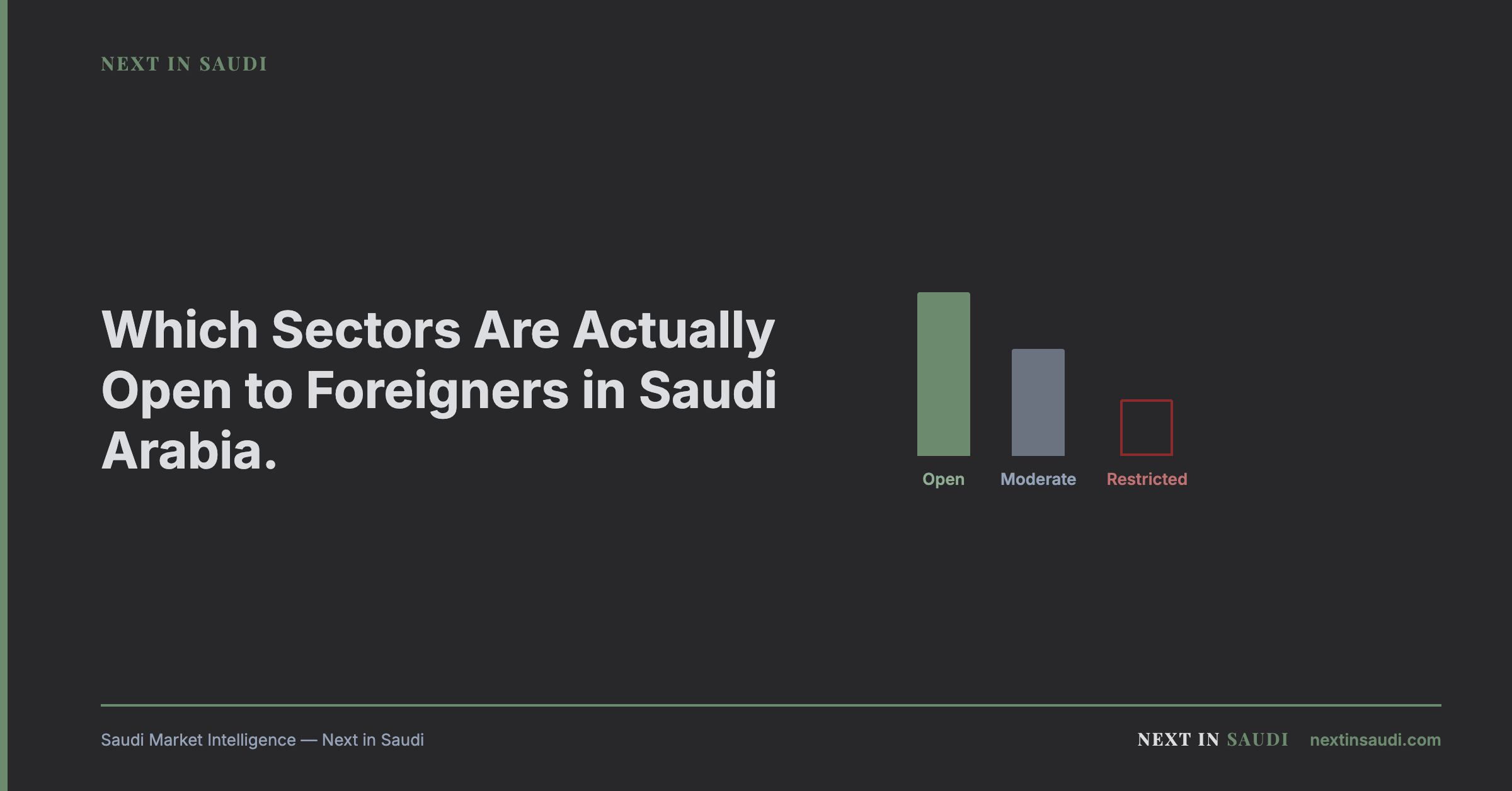
Genuinely open — strong and active international hiring:
Engineering, particularly EPC, oil and gas, and petrochemicals. Deep technical specialization and project-scale experience remain in short domestic supply, especially for senior and highly specialized roles.
Technology — AI, cloud infrastructure, cybersecurity, enterprise SaaS. Saudi Arabia’s tech buildout is moving faster than the domestic talent pipeline can currently fill, particularly at senior and highly specialized technical levels.
Healthcare — specialized clinical roles, hospital administration at senior levels. Vision 2030’s healthcare expansion continues to draw internationally trained specialists, particularly in areas with limited domestic training capacity.
Giga-project leadership and specialized delivery roles — master planning, large-scale construction management, hospitality operations at the senior level.
Moderately open — competitive, but real opportunity exists:
Finance — CFO-level, risk, private wealth, and specialized banking roles. Senior finance remains open, though mid-level and generalist finance roles face growing local competition.
Project management, particularly PMP-certified specialists in giga-project or industrial environments.
Genuinely restricted — heavy Saudization pressure:
HR generalist and administrative roles. This is one of the most heavily localized professions in the Kingdom. Saudi Arabia has invested significantly in developing domestic HR talent, and Nitaqat quotas here are aggressive.
Customer-facing retail and hospitality roles at entry to mid-level. A large, growing, well-trained Saudi national talent pool exists specifically for these positions.
General administrative, receptionist, and entry-level office roles across almost every sector.
THE SHIFT
The mental shift is simple but consequential: stop asking “is Saudi Arabia open to expats” and start asking “is my specific profession, at my specific seniority level, currently under-supplied or over-supplied domestically.” That single question redirects an enormous amount of wasted effort.
3 SPECIFIC ACTIONS
1. Identify exactly where your profession and seniority level sit on this spectrum.
Be honest about whether you’re in a genuinely scarce category or a heavily localized one. If it’s the latter, this doesn’t mean give up — it means your positioning needs to work much harder.
2. If you’re in a restricted category, narrow toward the specialized edge of your field.
A generalist HR professional faces real headwind. An HR professional with deep, specific expertise in compensation and benefits design for giga-project workforces is a different conversation entirely.
3. If you’re in an open category, move faster, not slower.
Scarce-skill categories still have competition from other qualified internationals. Don’t sit on an application for two weeks polishing it — the window in an open category is a window, not a permanent state.
CLOSING INSIGHT
Saudization was never designed to close the door on expats. It was designed to close it selectively, sector by sector, profession by profession. The professionals who succeed are the ones who stop guessing which side of that line they’re on — and find out.
Want to go deeper?
The Next in Saudi community gives you weekly live calls, personal CV and LinkedIn reviews, and direct guidance on your specific situation.
Every Friday, Next in Saudi publishes one article like this.
Thanks, very helpful information.