

4 MIN READ
A few weeks ago, a project engineer forwarded me two documents.
The first was his offer letter from a contractor in Riyadh. It was a good one. Base salary, housing and transport allowances, annual flights for his wife and two kids, and 30 days of leave. He signed it in March and resigned from his job in Cairo that same week.
The second was a screenshot of his Qiwa contract. It showed up in his account two weeks after he landed. It was in Arabic. He accepted it that afternoon.
I asked him if he’d read it.
“I assumed it said the same thing”.
It didn’t. The family tickets were gone. His leave was 21 days, not 30. His housing allowance was still there somewhere, but folded into one total number with no breakdown.
He didn’t notice for eight months. Then he asked HR about his children’s tickets, and HR pointed him to the contract.
So he sent me one question: “Which document is real?”
The honest answer is the one he never read.
I don’t think he was careless. I think he did what almost everyone does.
The offer letter feels like the deal. It’s detailed. It has the company logo. It has your signature on it. Everything that comes after feels like paperwork.
Years ago, that instinct was mostly fine. Paper contracts were common, and enforcement was uneven.
It isn’t fine anymore.
Since Saudi Arabia’s Labor Law amendments took effect on February 19, 2025, every employment contract has to be documented on Qiwa. That’s the record the Ministry sees. It’s the record a labor dispute looks at first. And it’s the record your next employer’s transfer request will run against.
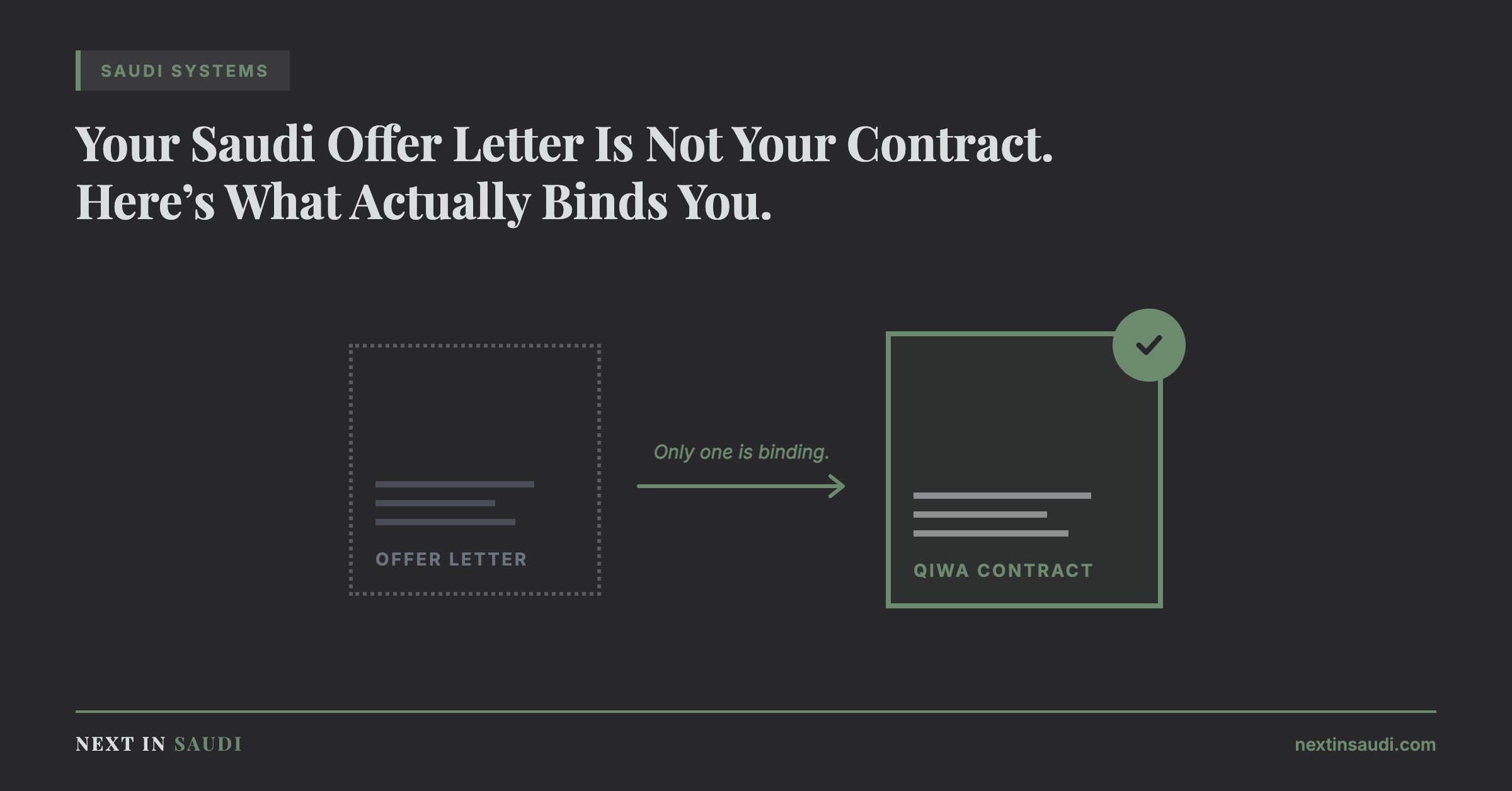
The offer letter is what they promised. The Qiwa contract is what they owe.
Here’s the part most people never realize.
Qiwa uses a standard template. You can’t change most of it. But there’s a section called “Additional Clauses”, where both sides can add terms, as long as they don’t contradict the template or the law.
That one section is where your negotiation actually lives.
There’s a floor under every Saudi contract. Your employer can’t go below it, and you don’t need to ask for it. Twenty-one days of annual leave, rising to 30 after five years. An end-of-service award. And a resignation that’s automatically accepted after 30 days if your employer doesn’t respond in writing.
But anything above that floor only exists if it’s written down.
The 30 days of leave from year one. The family tickets. The schooling support. The better insurance class. If it’s not in the additional clauses, it’s a nice memory of a conversation you once had.
A few other things worth knowing:
Your contract is fixed-term. If no term is stated, it now counts as one year from your start date. It no longer follows your Iqama the way it used to.
Probation can now run up to 180 days, and either side can walk away during it with no notice or compensation. But it has to be written into the Qiwa contract. If it isn’t, the legal probation period is zero.
And 180 days is the maximum, not the default. If you’re a senior hire moving a family across borders, it’s completely reasonable to ask for less, or none at all.
I don’t believe most companies remove benefits on purpose.
More often, someone in HR opens the template, fills in the basics, and adds nothing extra because nobody asked them to.
Someone needs to ask.
That someone is you.
If you already work in Saudi, log into Qiwa this week. Download your contract and put it next to your offer letter. Write down every benefit that’s in one and missing from the other. That list is your exposure.
If you’re holding an offer, email HR before you resign. Ask them to confirm, in writing, that every promised benefit will be entered as an additional clause. Don’t hand in your notice until you have that reply.
And if you don’t read Arabic, that’s not a reason to accept it unread. It’s a reason to get it translated first. Check five things: contract term, probation, salary breakdown, job title, and additional clauses.
Your negotiation doesn’t end when you sign the offer letter.
It ends when you press accept.
So before you do, ask yourself one simple question.
Which document is real?
Want to go deeper?
The Next in Saudi community gives you weekly live calls,
personal CV and LinkedIn reviews, and direct guidance on your specific situation.
Every Friday, Next in Saudi publishes one article like this.