

Nadia applied for a senior finance role at a Riyadh-based company on a Sunday. By the following Sunday, nothing. By week three, still nothing. She started checking her email obsessively, convinced the silence meant rejection.
In week five, she got a call for a first-round interview.
She wasn’t rejected. She was inside a process she couldn’t see — one with predictable stages, most of which happen entirely out of view, with no notification sent to the candidate at any point along the way.
This is the single biggest source of anxiety in the Saudi job search: not the process itself, but the not knowing. Once you can see the shape of what’s actually happening behind the silence, the waiting stops feeling like rejection and starts feeling like a process with a known rhythm.
THE PROBLEM
Professionals coming from markets with faster, more communicative hiring processes (much of Europe, North America, and even parts of the wider GCC) expect a response within days. When Saudi Arabia doesn’t deliver that, the instinct is to assume something went wrong.
Almost always, nothing went wrong. The process is simply longer, and structured differently, than what most international candidates are used to.
THE REALITY
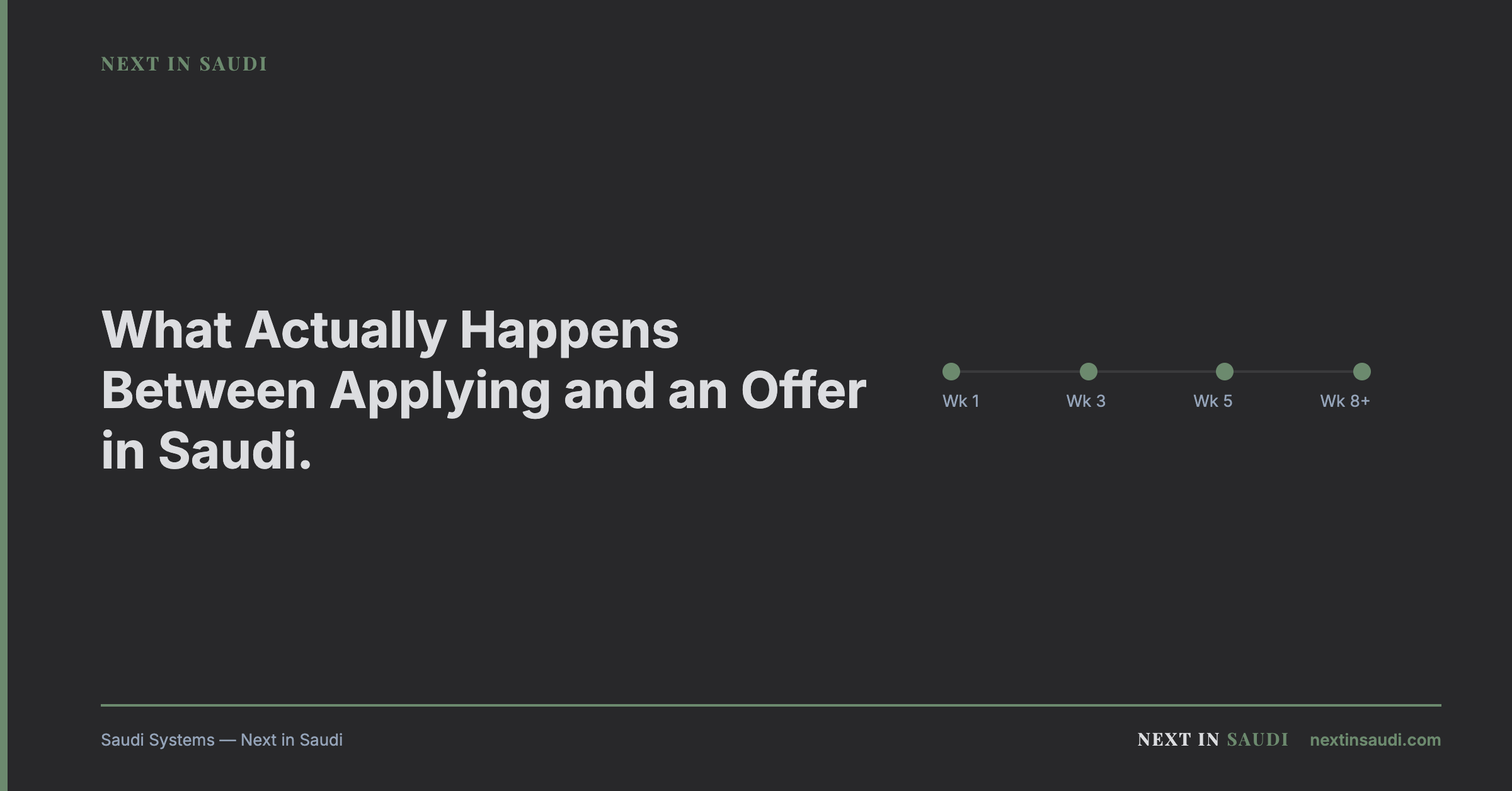
Here is what is typically happening, week by week, even when you hear nothing at all.
Week 1 — Collection.
Your application joins a pool. For roles with real interest, this pool can run into the hundreds. Nobody is reading individual CVs carefully yet — the system or a coordinator is doing a first structural pass, filtering for basic fit.
Week 2 — Shortlisting.
An HR coordinator or recruiter narrows the pool to a workable shortlist, often 10–20 candidates, based on the structural signals covered in CV format and keyword alignment. This is happening without any contact with you.
Week 3 — Internal alignment.
The shortlist gets shared with the hiring manager. In many Saudi organizations, this step also requires informal sign-off from someone above the hiring manager (a director, sometimes a more senior stakeholder) before interviews are even scheduled. This is the step most candidates never know exists, and it’s often where the longest delays happen.
Week 4–5 — First-round interviews.
Interviews begin, usually spaced out over one to two weeks rather than compressed into a few days, because multiple stakeholders’ calendars need to align — often across different departments or even different cities.
Week 6–7 — Second round or panel interview.
For senior or specialized roles, a second stage follows, sometimes involving more senior leadership or a panel format. This stage frequently includes another informal internal discussion before candidates are told anything.
Week 8+ — Approval and offer.
Once a preferred candidate is identified, the offer itself often requires budget confirmation, headcount approval, and — depending on the role and sector — visa and Saudization quota checks before anything is formally extended.
Total realistic timeline: 6 to 12 weeks for most mid-to-senior roles. Faster for urgent hires with fewer approval layers. Slower for senior or newly created positions, where the internal decision-making itself is still being worked out.
THE SHIFT
The mental shift that matters most here: silence is not a signal. In most Western hiring processes, silence after two weeks strongly suggests rejection. In Saudi Arabia, silence after two weeks is often just week two of a process. The absence of communication reflects the structure of the process, not a verdict on you.
3 SPECIFIC ACTIONS
1. Set your own timeline expectation at 6 to 12 weeks, not 2.
Recalibrating this number alone removes most of the unnecessary anxiety and premature follow-up messages that can accidentally read as impatience.
2. Use weeks 1–3 productively, not anxiously.
While your application is moving through collection and shortlisting, use that time to research the company, identify the likely hiring manager, and build your outreach — rather than refreshing your inbox.
3. Follow up once, around the three-week mark — not five times in five days.
A single, professional follow-up after roughly three weeks is appropriately timed against this real internal process. Anything sooner risks landing before any human has actually reached your application.
CLOSING INSIGHT
The Saudi hiring process isn’t slow because it’s broken. It’s slow because it has more internal stakeholders, more approval layers, and more informal alignment steps than most international candidates ever see. Once you can see the shape of the process, the silence stops being frightening — it just becomes week three.
Want to go deeper?
The Next in Saudi community gives you weekly live calls, personal CV and LinkedIn reviews, and direct guidance on your specific situation.
Every Friday, Next in Saudi publishes one article like this.
Thanks Adil for sharing these valuable insights.