

An HR director sent me her CV and asked why a role she was clearly qualified for had gone silent.
Eighteen years of experience. A strong employer list. I read her most recent role first.
“Responsible for managing the HR function. Oversaw recruitment, payroll, and employee relations. Led a team of 12. Ensured compliance with labor regulations”.
Every line was true. Not one line told me whether she was good at it.
That is the problem with most senior CVs. They describe the job. They do not describe the difference you made in it.
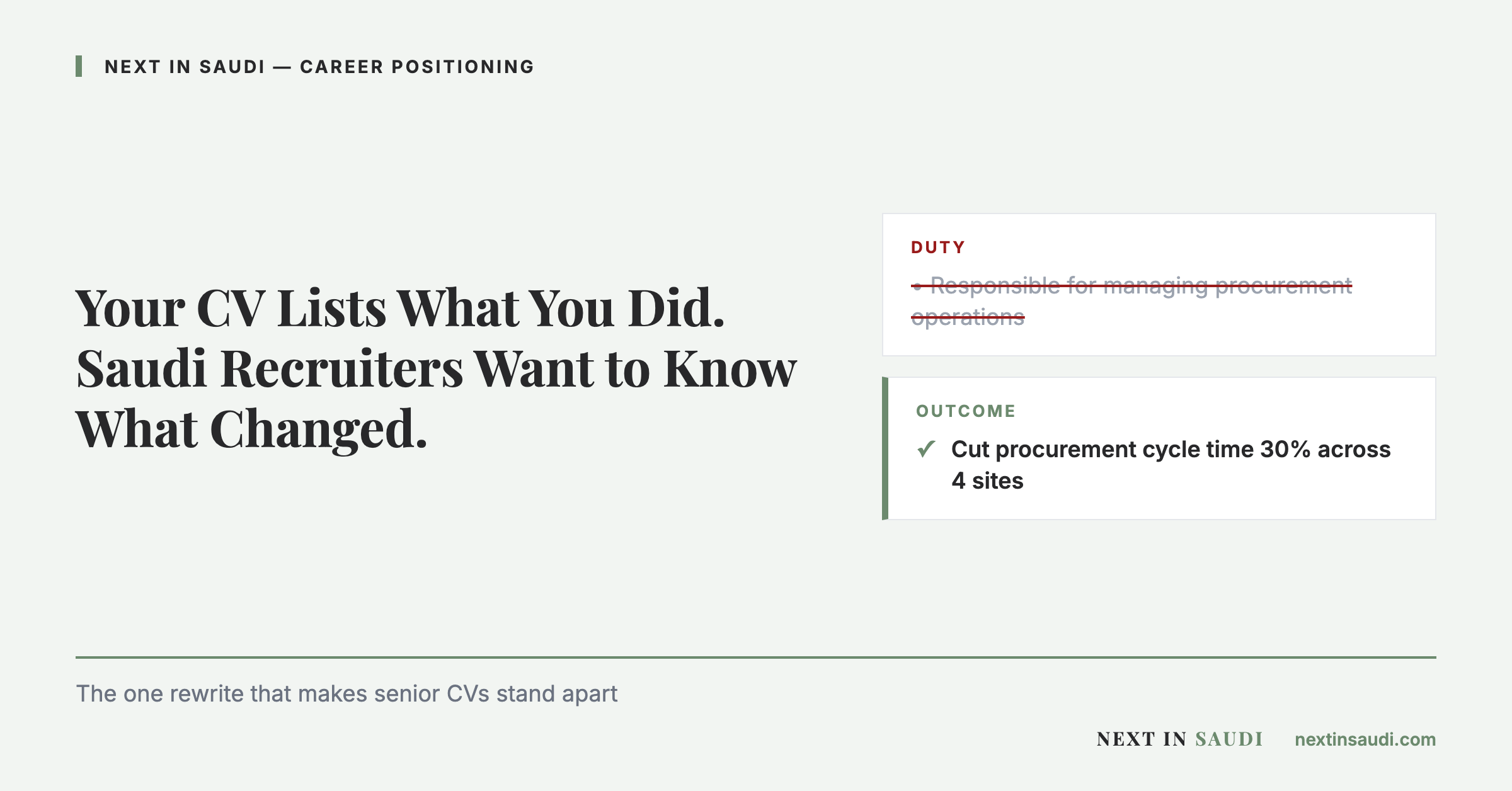
A Duty Describes the Seat. An Outcome Describes the Person.
Anyone who held your title did your duties. Two HR directors at two different companies could carry the same bullet points and have produced completely different results.
A duty tells a recruiter what the role required. An outcome tells them what happened because you were in it.
When a recruiter is sorting hundreds of CVs, duties are interchangeable. Outcomes are what make one candidate stand apart from the next one with the same title.
Why This Matters Even More in Saudi
Saudi organizations are in a period of heavy transformation. Many hiring managers are not asking “who has done this job before?” They are asking “who has changed something in an organization like ours?”
A candidate who reduced time-to-hire, restructured a function, delivered a project on a tight timeline, or built a team from scratch answers that question directly. A candidate who “oversaw recruitment” leaves the recruiter to guess.
Recruiters also take risk into account. An outcome with a number or a clear result is easier to trust and easier to defend when a recruiter has to put your name forward to a hiring manager.
What an Outcome Bullet Looks Like
The structure is simple: what you did, what changed, and how much.
Duty version:
“Responsible for recruitment across the organization”.
Outcome version:
“Rebuilt the recruitment process for a 900-person company, cutting average time-to-hire from 62 days to 38 and reducing agency spend by 27%”.
The second version tells the recruiter the scale, the problem, the action, and the result in one line.
If you do not have a precise number, a clear before-and-after still works. “Replaced a manual onboarding process with a structured 30-day program; new-hire attrition in the first year fell noticeably”. Use real figures where you have them. Do not invent them. A claim you cannot explain in an interview will cost you more than a missing number.
Where Senior Professionals Go Wrong
They write for people who already know them. Senior professionals often describe their work in the language of their own company. Recruiters outside it cannot translate that.
They list everything. Fifteen bullets per role dilutes the three that matter. Keep your strongest three to five outcomes per recent role and shorten the older ones.
They credit the team and lose themselves. Leading a team well is a strength. Writing only “the team achieved” makes it unclear what you personally owned. State the result and your role in producing it.
3 Specific Actions This Week
1. Rewrite the top three bullets of your most recent role.
Start each one with the result or the action, and include a number, a scale, or a before-and-after.
2. Run the “so what” test on every remaining bullet.
Read it and ask, “so what changed?” If the bullet cannot answer, rewrite it or cut it.
3. Match your outcomes to what Saudi employers are going through.
Look at three job descriptions you want. Identify the problem each one implies, such as scaling, restructuring, localization, or delivery on a deadline. Move the outcome that speaks to that problem to the top of the role.
The Line Worth Remembering
A duty proves you held the seat. An outcome proves the seat was better because you were in it.
Want to go deeper?
The Next in Saudi community gives you weekly live calls, personal CV and LinkedIn reviews, and direct guidance on your specific situation.
Every Friday, Next in Saudi publishes one article like this.