

A project manager once showed me his tracking spreadsheet.
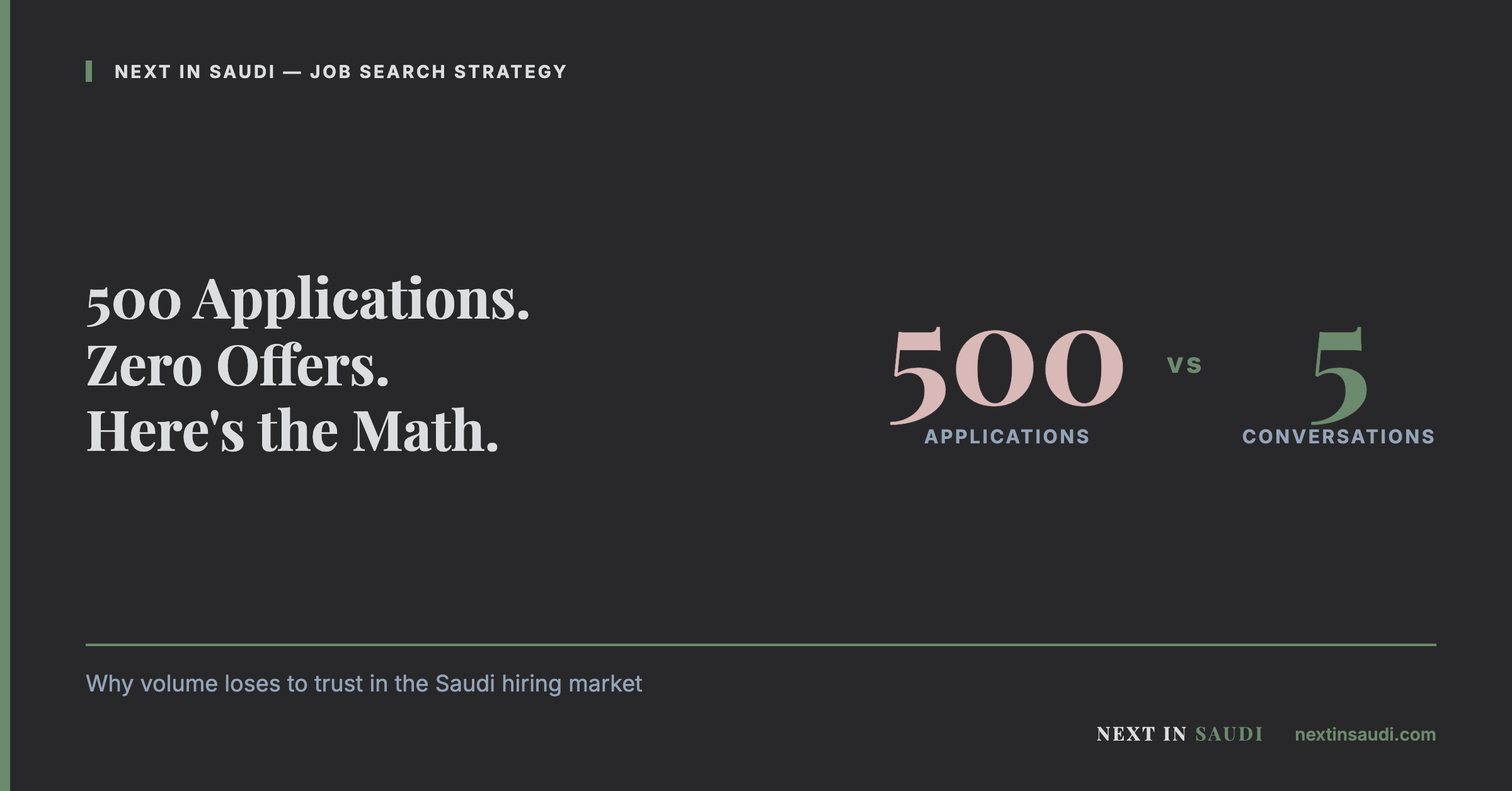
487 applications over eight months. Color-coded by status. Sorted by date. One of the most disciplined job search trackers I’ve ever seen.
Three interviews. Zero offers.
He asked me what he was doing wrong with his applications. That was the wrong question. He wasn’t doing anything wrong with his applications. He was doing the wrong thing entirely.
Applications Are a Volume Game Played Against Volume
Every one of his 487 applications entered the same system every other applicant enters — the published job market, Level 1, the most crowded layer of Saudi hiring. Hundreds of other people, many equally or more qualified, applied to the same postings through the same portal.
In that system, one more application is statistical noise. It does not change your odds meaningfully, because you are not being evaluated against the role. You are being evaluated against everyone else who also clicked apply.
Why 5 Conversations Can Outperform 500 Applications
A strategic conversation is not competing in the same system at all. When you talk directly with someone at a target company — a former colleague, a referral, someone you met through a mutual connection — you are not one CV in a stack of 800. You are a known quantity being discussed by name.
This is not a minor statistical advantage. It is a different category of consideration entirely. Referred candidates are frequently the first people considered, sometimes before a role is even formally posted. The conversation itself often does more than an application ever could, because it activates trust — and trust is the currency the Saudi market actually runs on.
The Math That Makes This Concrete
Consider what actually happens inside a company hiring for a role. A hiring manager receives 300 applications through the portal. They skim maybe 30 seriously. They interview 5 to 8. They hire 1.
Now consider what happens when someone the hiring manager trusts says, “You should talk to this person.” That conversation frequently skips straight to the interview stage — sometimes skips the interview stage’s initial screening entirely, going straight to a real conversation with the actual decision-maker.
487 applications gave the project manager three interviews. Five well-placed conversations, over the same eight months, would very plausibly have given him more, because each one operates in a completely different part of the funnel.
This Is Not an Argument Against Applying
Applications still matter. Some roles genuinely get filled through the published market, and applying costs little beyond time. The point is not to stop applying.
The point is that applications alone, at volume, are not a strategy. They are activity that feels productive because it is measurable — a spreadsheet, a number, a sense of progress — while producing a return that does not match the effort invested.
What a Strategic Conversation Actually Looks Like
It is not a cold LinkedIn message asking “any roles available?” That message gets ignored for good reason — it asks the other person to do work on your behalf with no context.
A strategic conversation starts with genuine interest in the person or the company, not an immediate ask. It might be a comment on their content, a specific question about their team’s work, a request to learn about their experience at the company. The ask, if there is one, comes later — after some real exchange has happened, not in the first message.
Why Professionals Default to Applications Anyway
Applications feel safer. They do not require putting yourself forward as a person — just a CV. They do not risk a conversation going nowhere or feeling awkward. They are easy to measure, which makes the lack of results feel like a numbers problem rather than a strategy problem.
Conversations feel harder because they are. They require initiating contact with a stranger, tolerating silence, and accepting that some will not lead anywhere. But the ones that do lead somewhere lead much further than an application ever does.
3 Specific Actions This Week
1. Pause the application volume for one week.
Not stop entirely — pause the “spray” version. Redirect that time toward the next two actions instead.
2. Identify 10 people connected to your target companies.
Former colleagues, mutual connections, alumni from your university now working in Saudi. This is your list for strategic conversations, not cold applications.
3. Reach out to 3 of them this week with a genuine, specific message.
Not “are you hiring.” A real question about their team, their move to Saudi, or their experience in the role. Let the relationship lead somewhere, rather than asking it to do all the work in message one.
The Line Worth Remembering
487 applications and three interviews is not a sign you need to apply more. It is a sign you have been playing a volume game in a market that actually runs on trust. Five real conversations, done properly, will outperform five hundred applications almost every time — because they are not competing in the same category at all.
Want to go deeper?
The Next in Saudi community gives you weekly live calls, personal CV and LinkedIn reviews, and direct guidance on your specific situation.
Every Friday, Next in Saudi publishes one article like this.